
Measuring Structural Behavior in MidJourney
Compositional Stability, Spatial Priors, and Geometry-First Diagnostics
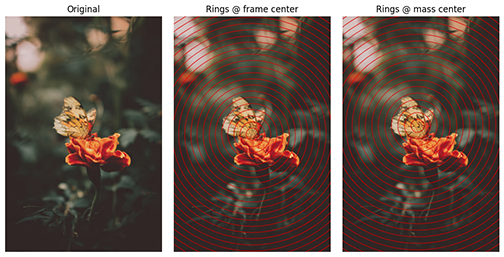
Evidence of Optimization-Induced Geometric Monoculture
MidJourney exhibits highly stable compositional behavior across diverse prompts. While semantic content varies widely, spatial structure converges on a narrow geometric attractor.
Using geometry-first diagnostics rather than semantic similarity metrics, this analysis identifies consistent spatial clustering, constrained centroid displacement, and stable void ratios across outputs. These patterns are consistent with optimization-induced structural regularization rather than dataset artifact alone, based on observed stability across prompt variation.
This summarizes observed behavior, measurement methodology, and implications for generative system evaluation and product development.
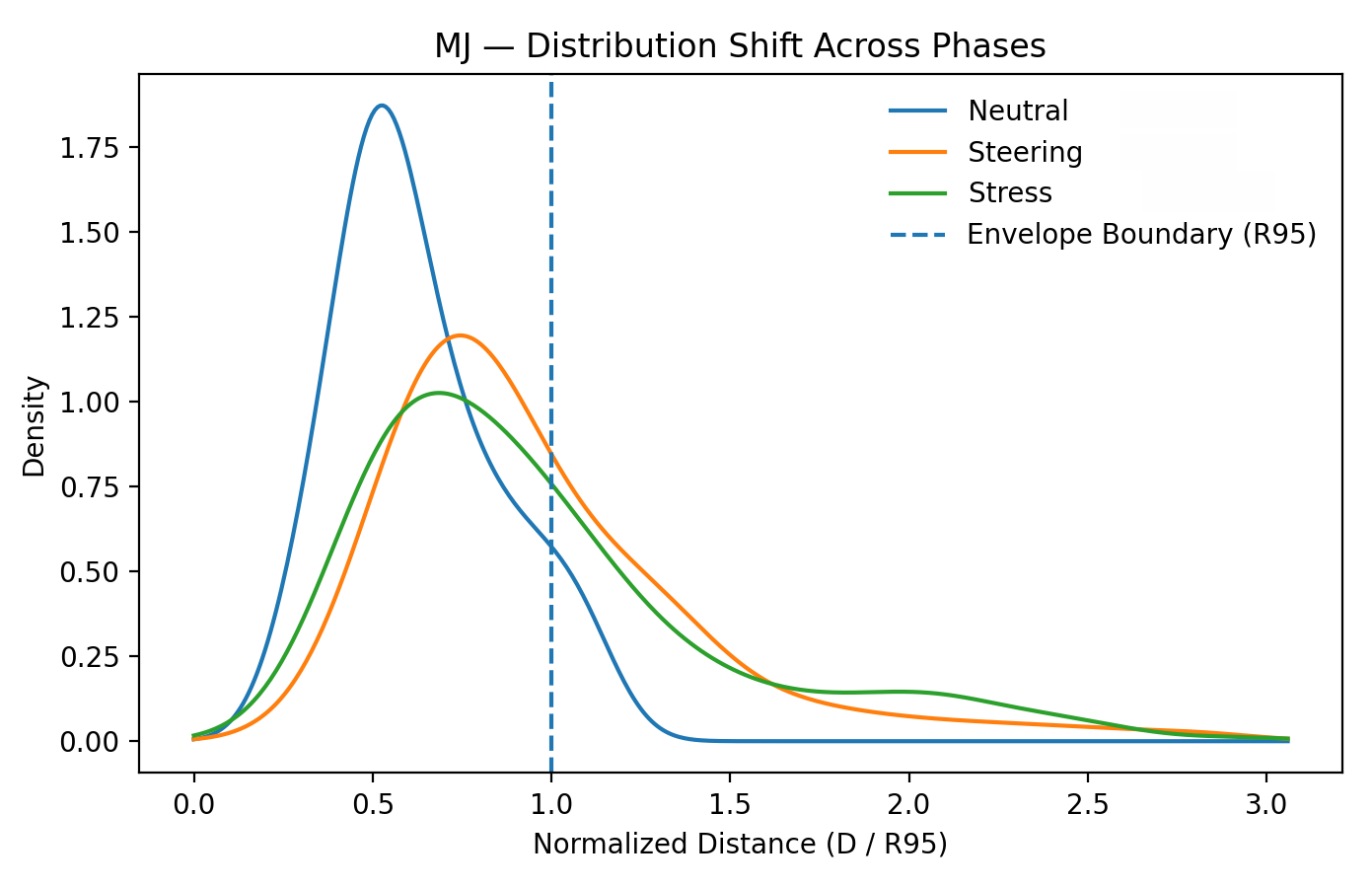
MidJourney Envelope Behavior and Elasticity
Envelope stiffness is low and elasticity ratio is moderate
Perturbation-1 steering stays close to Neutral
Perturbation-2 produces displacement, but distributions remain smooth
Key Metrics
Radial Mass Compliance Stability → Coefficient of variation ≈ 5.46%, indicating low placement variance across generations.
Spatial Envelope Compression → 50% of outputs fall within a 4.2% normalized radial band relative to frame center.
Centroid Displacement (Δr) → Mean displacement ≈ 0.0945, anchoring subject mass within ~10% of frame radius.
Void Ratio Locking → Background-to-subject spatial balance stabilizes around ~87%, largely independent of semantic content.
All values are frame-normalized and measured under standard prompt usage patterns without adversarial constraint forcing. Together, these metrics indicate strong convergence toward a default compositional basin.
What the Kernel Demonstrates
Four visualizations prove that structural behavior can be measured directly
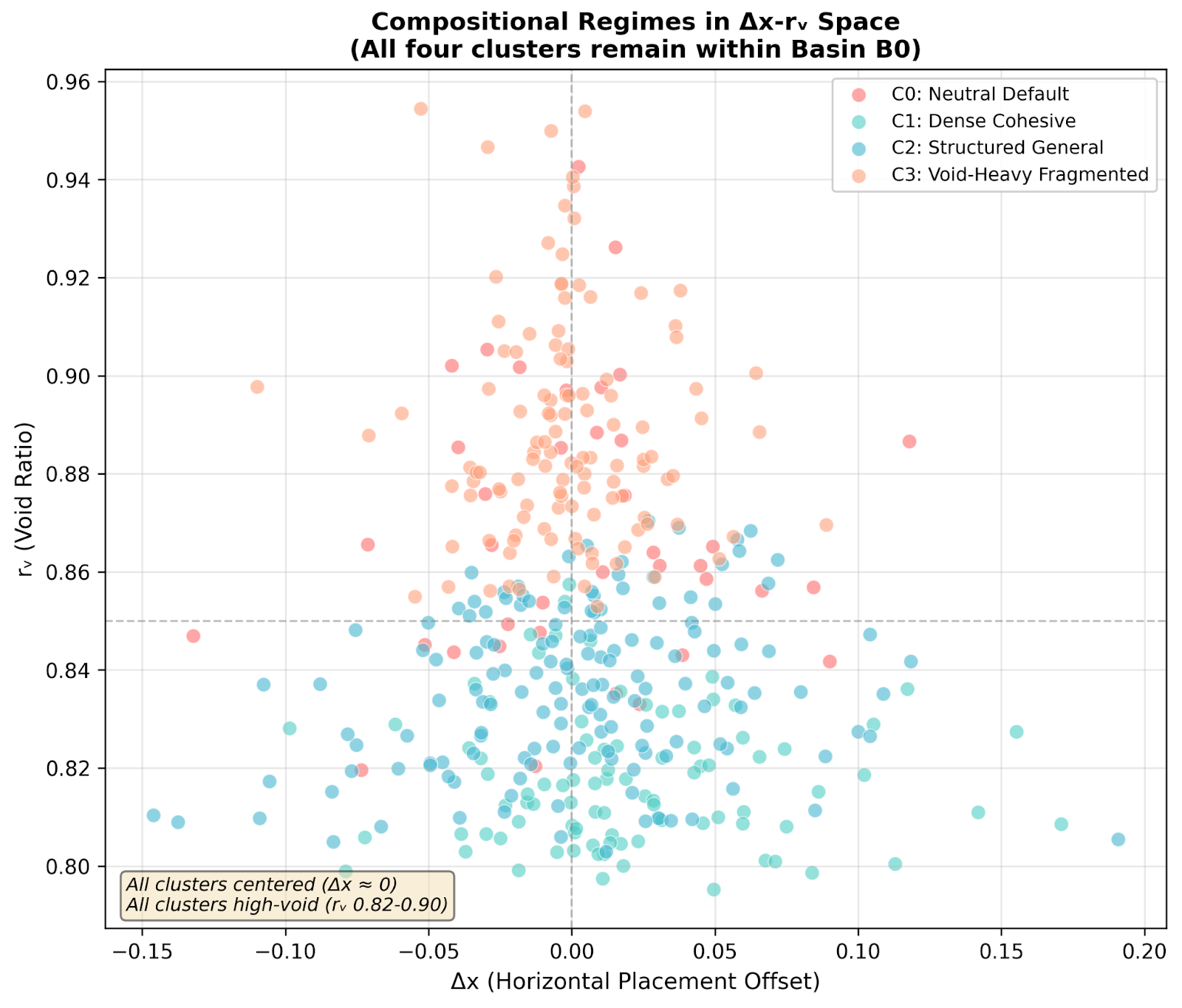
Interpretation
MidJourney does not simply “prefer centered subjects.” It consistently collapses output space into a stable geometric configuration that persists across unrelated prompts. This behavior produces high visual reliability and aesthetic consistency, but constrains structural diversity.
Why Geometry-First Measurement Matters
Semantic evaluation answers: “Does this image match the prompt?”
Geometric evaluation answers: “Where does the model place information?”
Across MidJourney outputs:
Semantic diversity explains less than 10% of observed spatial variance under standard prompt usage patterns.
Structural behavior remains consistent despite prompt variation
This reveals a decoupling between content diversity and compositional diversity.

Combined Effect
These forces converge toward a low-energy geometric attractor: A spatial configuration that simultaneously satisfies reconstruction fidelity, preference alignment, and inference stability. This contributes to the recognizable “look” across unrelated prompts.
Representative Stable Basin Values (C0)
Δx ≈ 0 (centered)
rᵥ = 0.855 (standard void)
ρᵣ = 37 (moderate density)
μ = 0.20 (fragmented)
Compositional role: When semantic content doesn't trigger subject-specific priors, images default to C0.
MidJourney allows elasticity and resists catastrophic regime collapse. When stressed, it bends geometry and partially returns toward baseline rather than snapping abruptly. MJ appears tuned for compositional continuity under moderate perturbation.
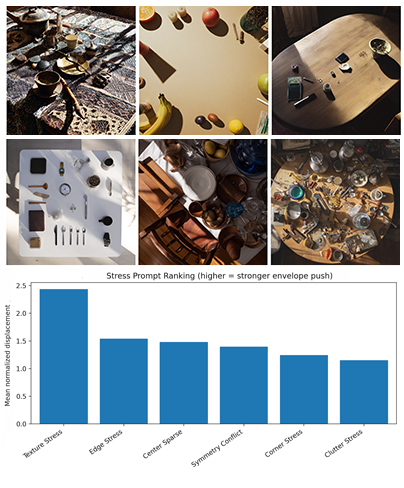
Perturbation Behavior (Early Failure Signals)
When prompts are incrementally varied:
Semantic attributes shift first
Contrast and tonal adjustments follow
Spatial structure resists movement longest
This ordering reveals structural inertia relative to semantic change.
Before visible semantic degradation appears, kernel metrics detect:
Rising edge density
Packing asymmetry
Peripheral stress accumulation
This enables pre-failure detection, identifying structural instability before output collapse becomes visually obvious.
Implications

Prompt Ceiling Effect
Strong spatial priors resist compositional reconfiguration through prompting alone. Users often attempt to “force” layout changes, encountering diminishing returns due to underlying geometric constraints. Measured envelope compression suggests practical compositional degrees of freedom are significantly narrower than semantic variation alone implies.
Perceived Novelty vs Structural Uniformity
High semantic variation masks low compositional variation. Users experience content novelty while geometry remains largely unchanged. This can contribute to:
Visual repetition
Creative stagnation
Style lock-in perception
Opportunity: Structural Instrumentation Layer
Direct measurement of compositional behavior enables:
Regression detection across model updates
Structural diversity benchmarking
Stability envelope monitoring
Constraint-aware generation tooling
Evaluation independent of aesthetic scoring
Stable spatial priors enable reliability at scale. Measuring them enables intentional control.